Your Painter Keeps Postponing the Start Date: What to Document Before Escalating
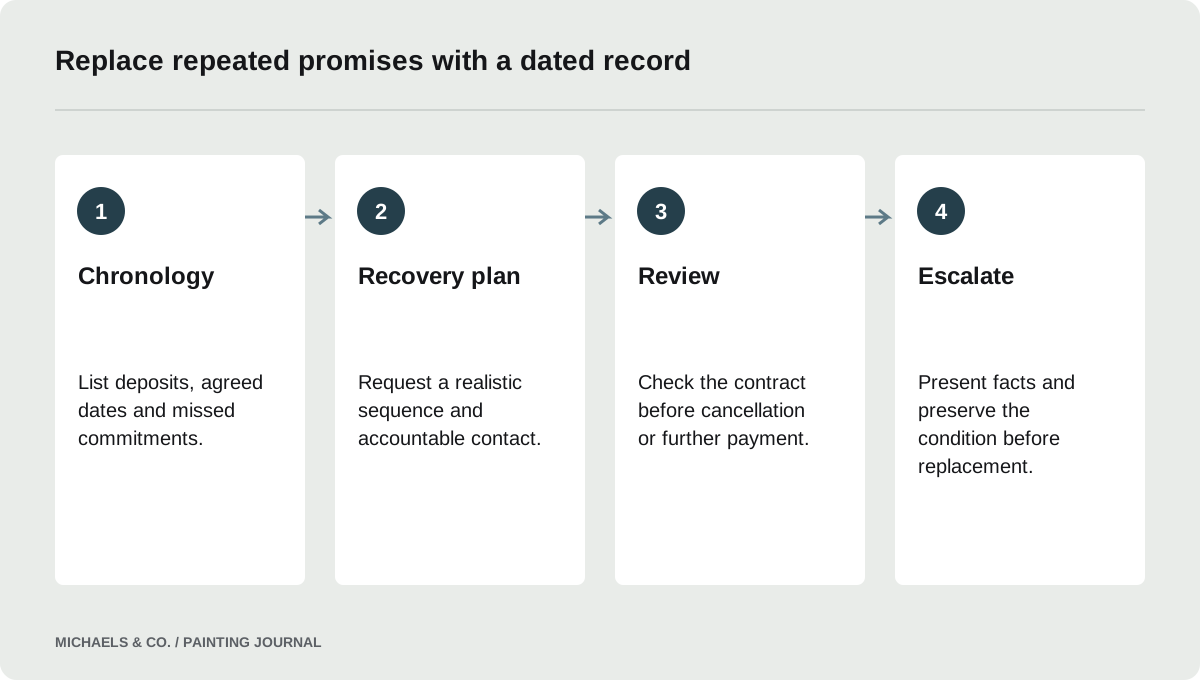
If a painter repeatedly postpones a job after receiving a deposit, build a dated record of the agreement, payments and missed commitments. Request a realistic written start and completion plan, with an explanation of what is preventing progress. Review cancellation and dispute terms before ending the contract or hiring a replacement. Weather or staffing problems do not automatically prove fraud, but repeated vague promises and unexplained advance requests deserve a concrete response.

Reconstruct the agreed schedule
Collect the accepted proposal, messages about availability, deposit receipt and later date changes. Distinguish an approximate scheduling window from a firm contractual date. Record what the contractor actually promised rather than relying on the date you hoped the work would begin.
In an Australian homeowner's account, a start expected within weeks remained unfulfilled three months after a deposit. The post's legal remedies cannot be transferred to Massachusetts, but its chronology demonstrates the value of a clear record. List each proposed date, the explanation given and whether the contractor provided a new commitment. That turns a general feeling of being strung along into a sequence that can be reviewed and addressed.
Separate uncertainty from an actual missed commitment
Exterior work can depend on conditions, and a contractor may encounter delays on another project. Those realities should be reflected in communication and the agreement. Ask whether the delay is tied to weather, access, materials, staffing or an unresolved scope decision.
A useful explanation connects the obstacle to a revised plan. “Next week” repeated indefinitely does not tell you what must change before the job starts. Conversely, an owner who has not provided agreed access or final selections may also be affecting the schedule. Review both sides of the record. The aim is to establish the current facts, not to create a one-sided narrative that ignores a dependency documented in the original agreement.
Request one written recovery plan
Send a concise message stating the agreed work, amount paid, original timing and the latest missed date. Ask for a specific start window, expected sequence, completion target and the resources or decisions needed to achieve it. Identify the person who will be your project contact.
The request should be actionable rather than a long expression of frustration. If the contractor proposes a partial start, ask what will be completed and whether the crew will remain until the planned stage is finished. Starting a small task does not necessarily resolve a staffing problem. For occupied homes, also ask how disruption will be limited if work pauses again. A recovery plan should make the next commitment easier to verify than the promises that preceded it.
Do not confuse cash requests with progress
An unscheduled advance should be explained in project terms. Ask whether it is required by the existing payment schedule, relates to approved additional work or represents a proposed change. Keep any decision in writing and obtain a receipt.
The FTC's consumer guidance identifies pressure and payment demands among warning signs worth investigating. A request for help with personal expenses is particularly different from a documented material purchase for your project. It does not independently establish a crime, but it gives you reason to avoid increasing an already uncertain exposure. Evaluate the contractor's actual progress, explanation and ability to complete the work instead of treating another payment as proof that a start is now guaranteed.
Protect the property while the schedule is unresolved
If preparation has already begun, inspect the condition without disturbing hazardous or unstable materials. Record exposed areas, removed hardware, stored products and any temporary protection that requires attention. Ask the contractor to explain what maintenance or protection is needed during the pause.
A homeowner's drywall and painting account describes a short project expanding through staffing gaps while work quality was also questioned. Delay and defective work can be separate issues, and both need records. Avoid allowing an argument about dates to obscure an immediate property-protection need. If urgent intervention is necessary, obtain appropriate professional advice and document why it was required, what was done and the condition before intervention.
Review termination and refund terms before acting
Read the agreement's cancellation, delay, notice and dispute provisions. Identify whether it specifies a process for addressing missed performance. Do not assume that sending one angry message automatically ends the contract or establishes the refund due.
Massachusetts HIC homeowner guidance describes covered-work resources and exemptions. The correct path depends on the actual job; interior painting and mixed improvement scopes should not be treated interchangeably without checking applicability. A qualified adviser can help assess the consequences of cancellation, replacement work or payment withholding. Preserve the original documents and avoid signing a new agreement that releases unresolved claims merely to obtain a proposed start date.
Prepare a factual escalation package
If the recovery plan fails or the contractor stops responding, assemble the information another person would need to understand the dispute.
- Accepted scope and the named contracting party.
- Payment amounts, dates and receipts.
- Original schedule and subsequent promises.
- Photographs of any work and remaining conditions.
- Your written requests and the contractor's replies.
- The specific result you are seeking.
That result might be a reliable completion plan, an accounting, a negotiated cancellation or another remedy supported by the agreement. Keep allegations proportionate to the evidence. Consumer agencies, mediation and court processes have different functions; verify the appropriate route rather than assuming an enforcement complaint automatically recovers the money.
Plan replacement work without destroying the record
If you move toward another contractor, first document what has been completed, which materials were applied and what remains. Ask for an itemized estimate separating completion from correction. The replacement painter may need product information and a substrate assessment before agreeing to coat over someone else's work.
Do not dispose of tools or materials left on site based on casual internet advice. Their ownership and lawful handling are separate questions. Likewise, avoid authorizing unnecessary removal that makes the original condition impossible to evaluate. A replacement plan should protect the property and finish the project while preserving the evidence needed to resolve the earlier agreement. Better documentation now also gives the new contractor a clearer starting scope and a more realistic schedule.
Questions & answers
How many missed start dates prove that a painter is scamming me?
There is no reliable number that proves fraud. Assess the agreement, explanations, communication, payments and actual performance. Repeated vague promises justify a written recovery request and possible escalation, but describe the facts rather than making an unsupported accusation. The appropriate remedy depends on the contract and applicable law.
Should I pay another advance to help the painter start?
First ask what contractual or project purpose the money serves and how it changes the completion plan. An unscheduled request should not be treated as a guarantee of performance. Review your existing exposure, retain records and seek advice if the contractor has repeatedly missed commitments or cannot provide a credible plan.
Can I hire someone else immediately?
Before committing, review the original contract and the consequences of termination or replacement. Document the current work and obtain an itemized completion estimate. Urgent property protection may require separate action, but replacing the contractor does not automatically resolve the earlier payment or ownership questions.
Sources & further reading
- FTC: How to avoid a home improvement scamFTC consumer guidance favors written scope and documented payments and identifies pressure and advance-payment warning signs.
- Massachusetts home improvement contract sample languageCovered HIC contracts require detailed scope, materials, dates and payment terms; applicability must be checked.
- Massachusetts HIC homeowner resourcesState guidance: interior painting is exempt from HIC registration; covered-work remedies require scope and eligibility checks.
Reader discussions
These conversations describe problems people encountered. They do not establish the cause of a defect or replace product instructions and applicable requirements.