California Painting Deposits and Home Improvement Payment Schedules
For a California home improvement contract subject to the ordinary deposit rule, an advance payment cannot exceed $1,000 or 10% of the contract price, whichever is less, excluding finance charges. Certain qualifying bond arrangements or registrar-approved joint control covering full performance and payment can provide statutory exceptions. Check the actual arrangement and applicable progress-payment rules with CSLB. First establish what kind of contract you have, then review its written scope, amounts and milestones.


Start with the contract and the scope
A deposit helps reserve resources for a painting project, while a progress payment covers a defined part of work already performed or materials already delivered. Treat these as different items. Start by identifying the parties, the property, the entire scope and the amount of the contract, including labor and materials. A residential repaint may be a California home improvement project; a commercial tenant improvement or another arrangement may have different rules. Do not assume the same deposit limit applies to every painting contract.
California's Contractors State License Board (CSLB) publishes a consumer guide to home improvement contracts. Use it to review the agreement and clarify how the rules apply to your situation before paying. An estimate should describe the surfaces, preparation, products, cleanup and exclusions clearly enough that the payment terms can be understood alongside the promised work.
Calculate the ordinary down payment limit
For a covered home improvement contract without an applicable exception, the ordinary maximum down payment is the lesser of $1,000 or 10% of the contract price, excluding finance charges. It is a ceiling, not a required deposit. A $6,000 contract has a $600 maximum down payment; for an $18,000 contract the maximum is $1,000. A contractor and owner may agree on a smaller amount or no down payment at all.
The California Business and Professions Code, section 7159.5(a)(8) provides exceptions for certain qualifying bonds, bond equivalents or registrar-approved joint control covering full performance and payment. A blanket performance and payment bond approved and on file with CSLB is one example. This is not the same as an ordinary contractor license bond. If a contractor claims the exception, check the current license record and ask CSLB about the particular arrangement before relying on it. CSLB explains that its approved blanket bond exception can allow a larger advance; do not assume a verbal claim of being bonded establishes that protection.
Do not turn a material order into an extra deposit
Special-order materials do not create a separate exception to the usual home improvement down payment limit, according to CSLB. Ask whether a proposed scheduling fee, procurement charge or material advance is part of the up-front amount and how it appears in the contract. Renaming a payment does not answer the question of whether the amount is permitted.
There are practical alternatives to an unexplained advance: identify the product and delivery milestone, specify when an agreed progress payment becomes due, and discuss any purchasing arrangement before signing. Do not assume that payment may be collected simply because an item was ordered. The contract, the delivery or work performed, and any applicable exception all matter. For an unusual arrangement, ask CSLB or an appropriate California professional to review the facts.
Connect progress payments to completed work
Under the ordinary requirements, if payments other than the down payment are due before completion, the schedule should state the dollar amount for each phase and specifically describe the work, services, materials or equipment tied to it. The CSLB progress-payment alert explains that, apart from the allowed down payment, a contractor generally cannot collect for work not performed or materials not delivered on covered home improvement work.
For a larger exterior job, a schedule might identify preparation of specified surfaces, delivery of specified materials and later application milestones, with an amount for each. Those examples are planning prompts, not an automatic finding that a particular percentage is lawful. Unless a statutory exception applies, check that the amount demanded does not exceed the value of work performed or materials delivered, and that the identified milestone actually occurred. The qualifying protections described above can also create exceptions to the ordinary progress-payment provisions; verify the actual arrangement with CSLB. A completion-only payment may also be agreed.
Write the details before work begins
Before signing, read the agreement as a project description as well as a payment plan. It should identify the contractor and, where applicable, license information; the surfaces and locations included; how loose paint and defects will be prepared; the intended products and coats; access and protection; approximate timing; cleanup; and any warranties offered. Ask who will obtain any necessary approvals and whether their costs are included.
- Compare the total price with the proposed initial payment.
- Match each progress amount to a clear phase and actual work or delivery.
- Clarify excluded repairs, uncertain conditions and any allowances.
- Confirm how changes to price and completion timing will be documented.
- Keep the signed contract, notices, invoices and receipts together.
Read the applicable cancellation notices as part of the agreement. A quick online estimate or a promise made during a walk-through is not a substitute for the signed terms.
Put changes in writing
A painting crew may uncover damaged wood or failed coating after preparation starts. Ask for the finding to be documented and decide who will repair it before authorizing an expanded scope. A written change order should describe the added or removed work, any price adjustment, and any effect on schedule. For covered home improvement work, review and sign the change before the changed work proceeds as required by the applicable rules.
When a change affects the payment plan, ask for an updated schedule that shows the new total, what has already been paid and what remains. Do not infer that a repair is included merely because it is needed for a good finish, or that an open-ended authorization sets a price. A few photographs and a precise description help both parties review the same condition.
Keep payment and lien records
Use a traceable payment method and retain invoices and receipts showing the date, amount and phase paid. If subcontractors or suppliers are involved, paying the prime contractor alone does not prove that all potential lien claimants have been paid. CSLB explains conditional and unconditional lien releases and their different effects.
Ask which releases are appropriate to the payment and who must sign them. A conditional release is effective when the specified payment is actually made; an unconditional release states that the payment has been received. Read the particular form and retain it with proof of payment. Do not sign a document saying someone was paid before that is true. Resolve a discrepancy with the parties or get advice appropriate to the circumstances.
Review the finish and the final balance
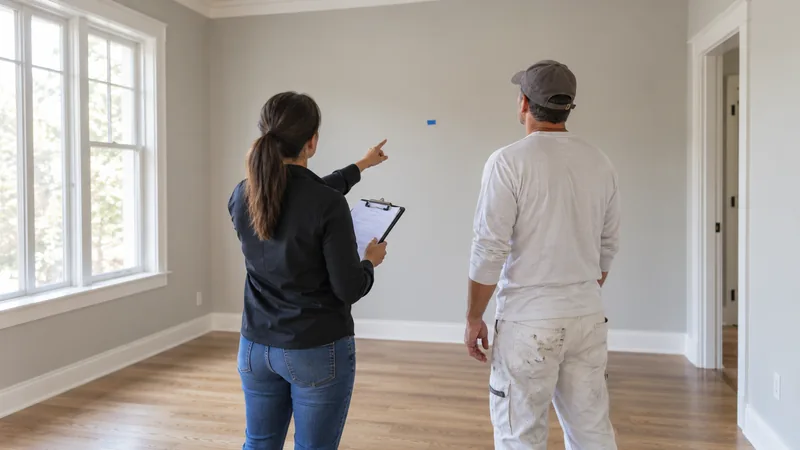
Arrange a walk-through against the written scope before the agreed completion payment becomes due. Look at the included surfaces in reasonable light, check that doors and windows operate, and make a dated list of incomplete items or damage concerns. Agree in writing how outstanding items will be addressed and when. An inspection is useful, but it does not give either party a general right to ignore payment terms or applicable law.
Contractor practices vary. In an online discussion about painting deposits, painters describe different percentages and schedules. The discussion is an anecdote, not evidence of California law or a recommendation to copy those figures. For a Bay Area home improvement project, use the actual contract, the CSLB guidance and the facts of the job.
Questions & answers
How much can a California painting contractor ask for as a deposit?
For a home improvement contract subject to the ordinary rule, the down payment cannot exceed $1,000 or 10% of the contract price, whichever is less, excluding finance charges. Certain qualifying bond arrangements or registrar-approved joint control covering full performance and payment can provide statutory exceptions. The deposit can be lower or zero. Check the contract type and any claimed exception with CSLB.
Can the painter ask for more because the paint is special order?
CSLB says special-order materials do not create an exception to the ordinary home improvement down payment limit. Discuss how materials and their delivery are documented. An applicable progress payment must be tied to the specified work performed or materials supplied, subject to the relevant legal rules.
Are progress payments required for every home painting job?
No. A contract can provide for payment on completion rather than progress payments. Under the ordinary requirements, if a covered home improvement contract calls for payments before completion in addition to a down payment, the schedule must describe the phases and amounts. Qualifying statutory exceptions can apply; verify the actual arrangement.
Does the deposit cap apply to a commercial painting contract?
Do not automatically apply a residential home improvement rule to a commercial agreement. Identify the parties, property and work, then determine the applicable contract rules. In either case, a specific written scope and payment schedule help the parties understand their obligations.
Sources & further reading
- CSLB: Consumer guide to home improvement contractsDown payment limit, special-order materials, qualifying bond exception, payment schedules and written changes.
- CSLB: Contracts and binding agreementsExplains written home improvement contracts and the rare blanket performance and payment bond exception.
- CSLB: Home improvement progress paymentsExplains progress payments, completed work and delivered materials for home improvement projects.
- CSLB: Conditional and unconditional lien releasesExplains payment-related releases and the distinction between conditional and unconditional forms.
- CSLB: California Contractors License Law and Reference Book 2026Business and Professions Code section 7159.5(a)(8): qualifying bond and registrar-approved joint-control exceptions to specified deposit and progress-payment requirements.
Reader discussions
These conversations describe problems people encountered. They do not establish the cause of a defect or replace product instructions and applicable requirements.