Choosing Airless Spray Tip Size for Walls, Doors and Primer
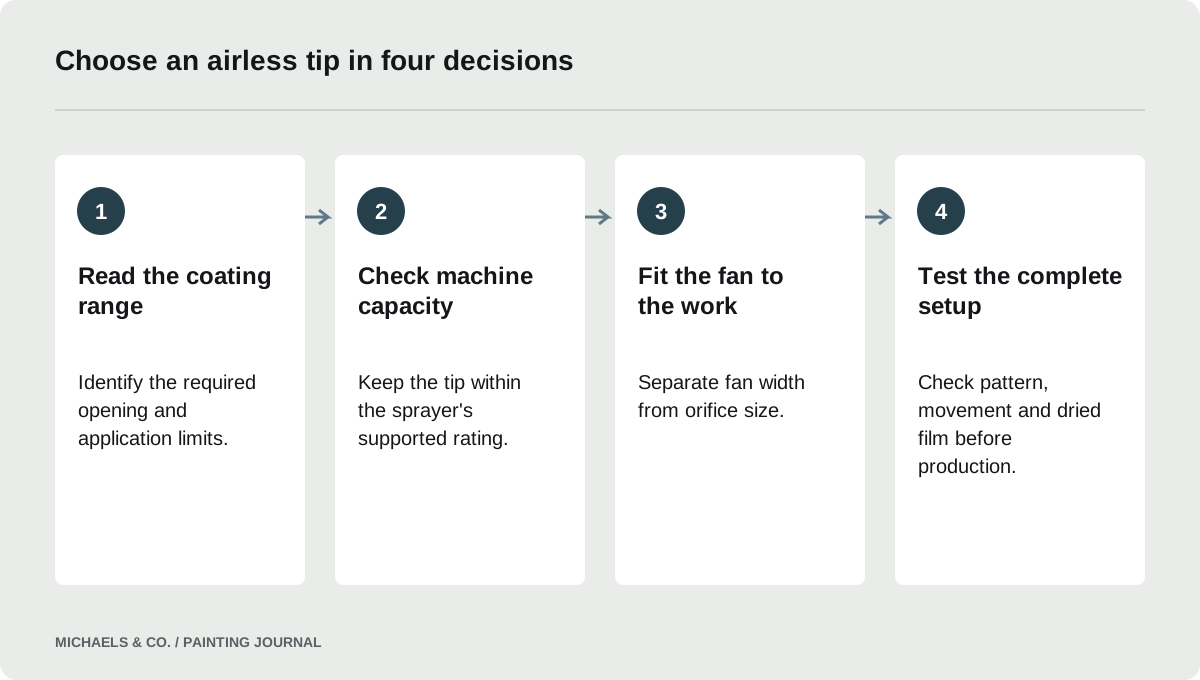
Choose an airless tip by two separate dimensions: fan width and orifice size. In Graco's common three-digit system, a 515 gives a nominal 10-inch fan at 12 inches from the surface and a 0.015-inch orifice. The coating's recommended range and the sprayer's maximum supported tip must overlap. Then select a fan suited to the work and test the pattern at an appropriate pressure.

Decode the number before buying a tip
A tip number is not a simple quality grade or a single measure of size. Graco's explanation of airless spray tips describes a common three-digit system: double the first digit for nominal fan width in inches at a 12-inch distance; read the last two digits as thousandths of an inch for the opening. Thus 515 represents a 10-inch fan and a 0.015-inch orifice.
The distinction matters because changing only the first digit changes the area across which material is distributed, while changing the last two changes the opening. A 315 and 515 share the same nominal orifice but different fans. Do not assume a narrower fan is automatically gentler. With comparable output and movement, concentrating material across a narrower strip can increase build. Check the exact tip family's specifications because compatibility and stated fan ranges can vary between products.
Find the overlap between paint and pump limits
Read the coating's airless recommendations and the equipment's maximum tip rating side by side. The useful choice is within both. A paint requiring a larger opening than the sprayer supports is a compatibility problem, not an invitation to install an oversized tip or add unapproved thinner.
For a concrete product example, the Stix SXA-110 technical sheet lists a 0.013–0.017-inch airless tip range and says not to thin. That range still has to fit the selected machine, gun and compatible tip system. Another primer may specify something different, even if both cans say bonding primer. Record the exact product code rather than choosing from a general “primer” chart. If the two specifications do not overlap, change equipment, coating system with manufacturer guidance, or application method. Avoid buying accessories first and trying to force the coating to fit them afterward.
Choose the fan for the surface width
Broad walls allow a wider fan than narrow door rails or trim. A fan much wider than the target sends more material beyond its edges and complicates control. A fan that is unnecessarily narrow requires more passes across a large surface. The best choice supports a comfortable, repeatable movement with the required overlap.
| Illustrative tip code | Nominal fan at 12 inches | Orifice |
|---|---|---|
| 315 | 6 inches | 0.015 inch |
| 515 | 10 inches | 0.015 inch |
| 517 | 10 inches | 0.017 inch |
These examples explain the numbering, not recommendations for every door or wall paint. A coating may need a different orifice, and a fine-finish tip family may have its own operating guidance. Select the product-compatible opening first, then choose an available fan that suits the geometry.
Treat pressure as a controlled adjustment
More pressure is not automatically a better finish. Use the equipment and tip instructions to establish a test pattern, then seek the lowest permitted setting that produces the required even fan with the selected material. Do not copy a pressure from an unrelated sprayer or paint discussion. Gauge readings, tip condition and material behavior all matter.
A Reddit account of an unsuccessful airless application illustrates how quickly a beginner can end up changing multiple variables at once. Record the tip, product, pressure setting and test conditions before adjusting. Change one appropriate variable at a time and test off the finished surface. If a sound pattern cannot be obtained within the approved setup, stop and investigate compatibility or equipment condition. Continuing at maximum pressure can waste coating and conceal the original cause without making the process repeatable.
Keep distance and movement consistent
Tip selection assumes controlled technique. Holding the gun much farther away spreads the pattern differently and changes how material reaches the surface. Arcing the wrist changes distance across each pass. Starting or stopping while the gun remains pointed at one spot can concentrate coating at the ends.
Graco's spray-technique guidance uses roughly 12 inches of distance and about 50% overlap as general technique references. The actual equipment and coating instructions remain controlling. Practice moving parallel to a sample surface and coordinating triggering with movement. A pattern that looks acceptable on a short stationary test can still produce an uneven wall if the gun angle and speed vary. Include corners and edges in practice, since those are where operators often slow down or double-coat an area unintentionally. The goal is a usable application rhythm, not merely an attractive fan shape.
Check filters, wear and cleaning compatibility
The tip is one part of the fluid path. The selected coating and tip may require an appropriate filter arrangement, and dried material can interfere with delivery. Confirm the specified components before use. Do not remove filtration or modify hardware simply to make a troublesome coating pass through.
Tip wear also changes performance: an old tip with a readable number may no longer deliver like a new tip of that size. Compare its pattern and service condition rather than relying only on the stamped code. Follow the equipment manual's pressure-relief procedure before servicing, changing tips or addressing a blockage. Never use a hand to locate or stop a high-pressure leak. Keep the guard and safety devices in their intended configuration. If the system behaves unpredictably after basic approved checks, seek service rather than improvising repairs around a pressurized gun.
Graco's airless-safety guidance directs operators to the model-specific manual for its warnings and procedures. Review that manual before startup, not only when a problem interrupts spraying.
Make a small setup record for the job
Before production, write down the coating name and product number, approved tip range, chosen tip family and code, compatible guard, filter arrangement and equipment model. Add the test conditions and whether the dried sample met the intended appearance. This record makes a replacement tip or a second workday easier to manage.
Check coating consumption against the product's specified coverage and film-build requirements rather than judging only color hiding. A wide fan can make an area look colored while leaving insufficient build, and a narrow fan can overapply material if movement is too slow. Do not compensate for poor hiding by repeatedly misting one spot. Use the required coat sequence and allow the specified drying interval. Once the setup works, preserve it consistently and recheck after a material change, tip replacement or substantial change in conditions. A documented setup is more reliable than remembering that “515 worked last time.”
Questions & answers
Does a 517 tip make a wider fan than a 515?
In the common numbering system, both have the same nominal fan width because the first digit is the same. The 517 has a larger orifice. Whether it is suitable depends on the coating and the sprayer's supported tip size, not just the desired application speed.
Can I use a smaller tip to make thick primer spray better?
Not necessarily. The coating specifies an appropriate orifice range, and a smaller opening may be incompatible with its application requirements. Check the exact primer sheet and machine capacity. Do not thin a product that prohibits thinning to compensate for a mismatched setup.
Why did my old tip stop producing the same pattern?
Wear, contamination, material changes or equipment condition can alter the result. Inspect using the manufacturer's procedure and compare against a known suitable setup. The stamped number describes the original tip size; it does not guarantee an unchanged pattern after service.
Sources & further reading
- Graco: Spray TechniquesTest the pattern, use suitable pressure and tip, keep consistent distance and overlap passes.
- INSL-X Stix SXA-110 Technical Data SheetClean, sound surfaces and compatible topcoats remain required; degloss challenging glossy surfaces and test questionable substrates.
- Graco: Choosing and Understanding Airless Spray TipsTip numbering distinguishes fan width and orifice; coating recommendations and sprayer capacity constrain selection.
- Graco: Airless Sprayer SafetyFollow equipment-specific warnings and procedures for injection, fire, toxicity and other airless-spray hazards.
Reader discussions
These conversations describe problems people encountered. They do not establish the cause of a defect or replace product instructions and applicable requirements.