Keeping an Occupied Painting Site Usable: Access, Daily Cleanup, and Stop-Work Decisions
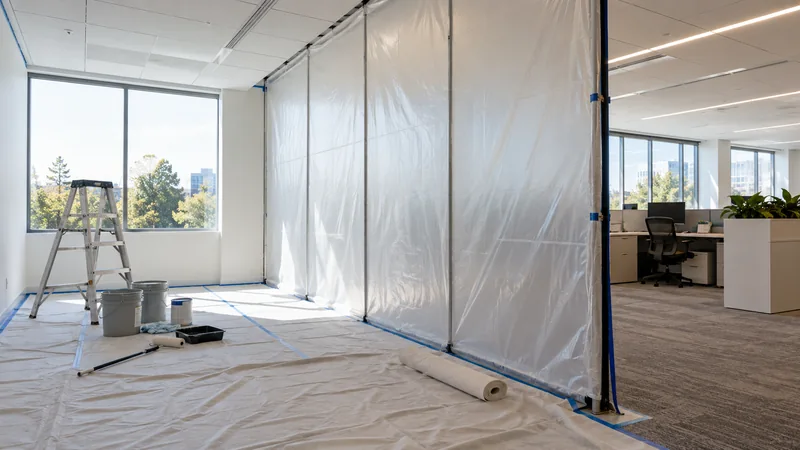
An occupied painting site needs a coordinated plan for access, storage, daily cleanup, communication and release of completed areas. Identify who uses the building during every shift and who can stop or change the work if conditions differ from the plan. A barrier or sign is useful only within a workable site-specific arrangement. Product, lead and workplace-safety requirements remain separate obligations that the coordination plan must accommodate.
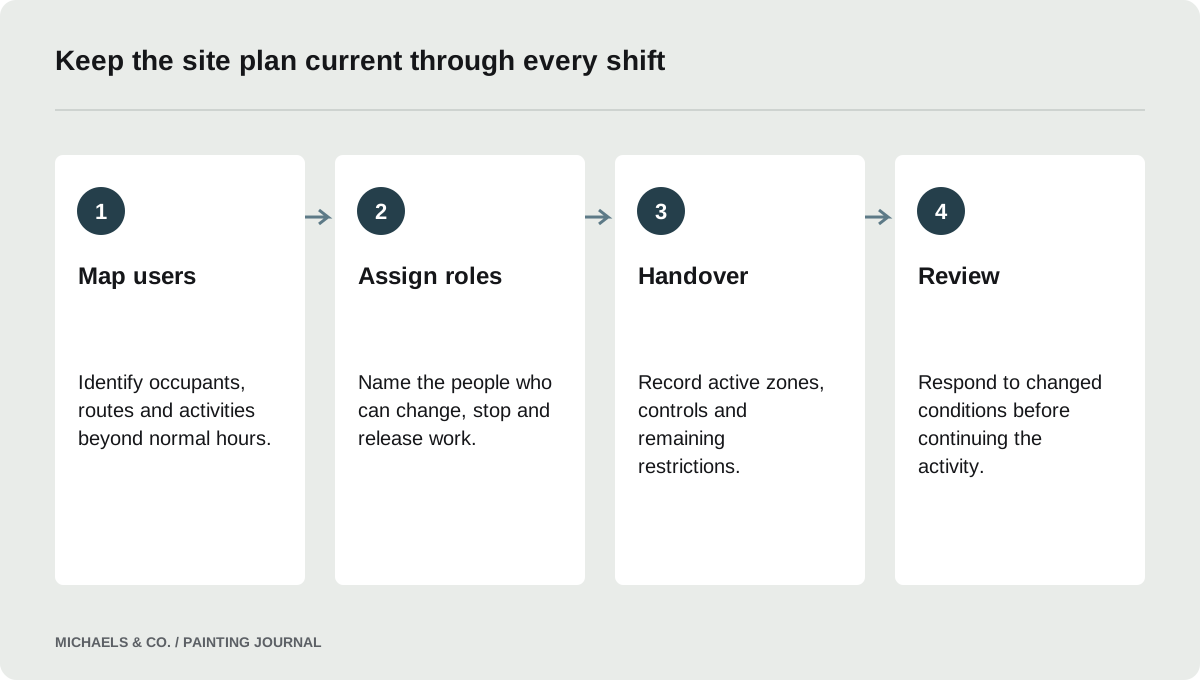
Map the building's actual daily use
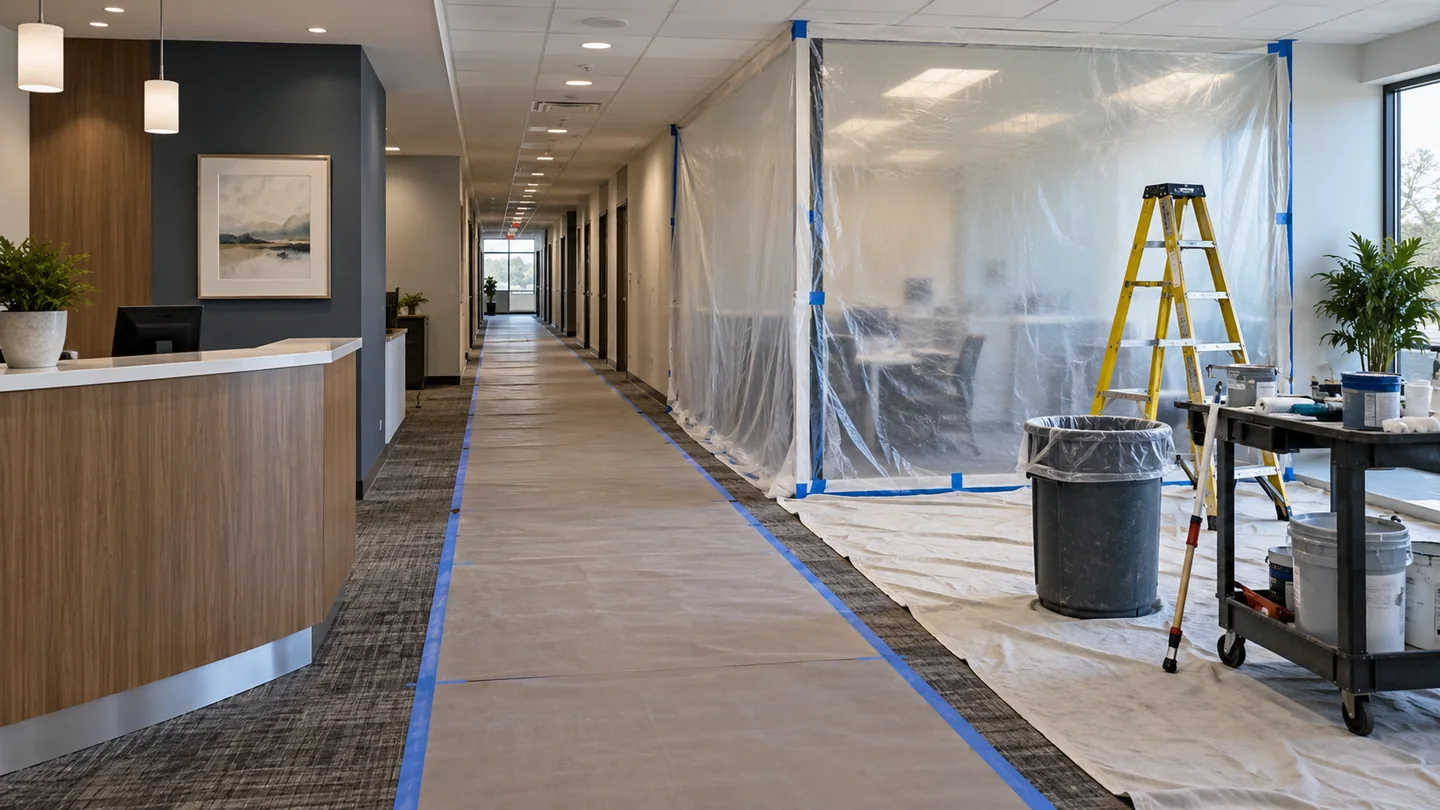
List the people who may enter before, during and after the painting shift. Include employees, residents, visitors, cleaners, security staff and other contractors. Mark the routes they need and the rooms that must remain available. A plan based only on the owner's normal hours can miss the first person who arrives in the morning.
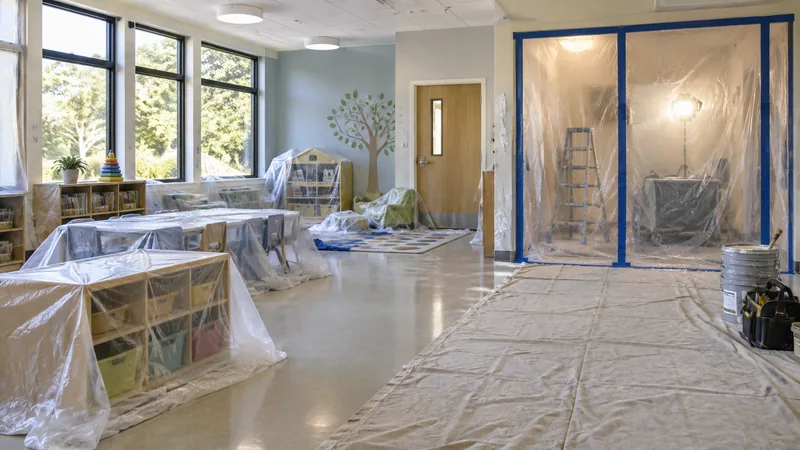
A student's account of a class entering a renovation area describes the custodian not knowing that occupants were present. The reported exposure was not independently established, but the scheduling breakdown is a concrete lesson. Room allocation and contractor scheduling need one shared record. Someone must be responsible for checking that a newly scheduled activity does not conflict with the active work zone.
Coordinate work boundaries and circulation
The work zone must account for preparation, application, equipment and movement of materials. Ask the responsible building personnel to review circulation and required access. Avoid creating a temporary route through an active work area simply because it is shorter.
The EPA's renovation guidance explains the role of distance, barriers, ventilation coordination and cleanup in reducing occupant contact with pollutants. It is not a substitute for a building-specific plan or applicable safety requirements. A plastic boundary does not automatically establish safe access or control shared air paths. If the proposed arrangement cannot maintain the necessary separation and circulation, revise the sequence or occupancy before the activity begins.
Plan storage and deliveries as part of the scope
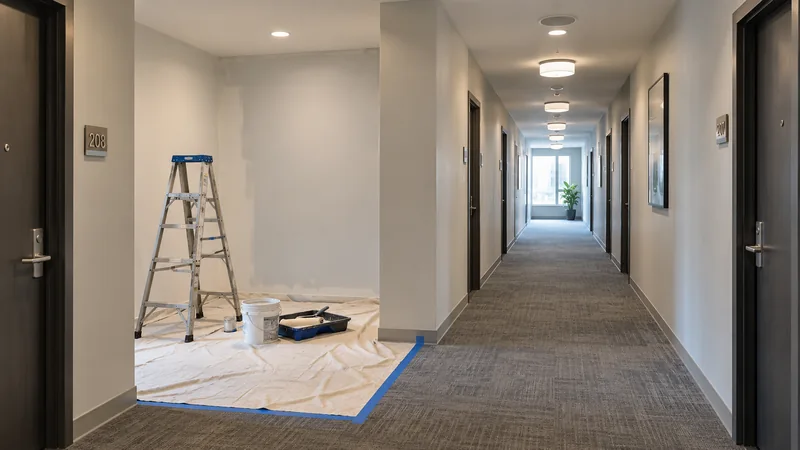
Paint, ladders, tools, protected contents and waste need approved locations. Without a plan, corridors or shared rooms can become informal staging areas. Identify who controls those spaces and when they must be cleared. Coordinate deliveries with the building's operations rather than assuming the crew can unload wherever convenient.
- Mark authorized storage and loading areas.
- Keep product containers and equipment under the agreed control.
- Assign movement of furniture and sensitive equipment.
- Plan waste handling and removal timing.
- Check shared areas at the end of each shift.
These coordination tasks do not replace requirements for product storage or workplace safety. They make those responsibilities visible so the contractor, owner and occupants do not work from conflicting assumptions about where materials may be left.
Use daily handovers rather than one initial briefing
Conditions change as rooms are completed, new preparation begins and other trades arrive. At each handover, identify active zones, completed areas, remaining restrictions and any change in products or methods. Confirm who is responsible for controls that remain after the crew leaves.
A teacher's report of overnight spray-paint odor illustrates why an activity can affect the next shift even when application is finished. The account is not a measured exposure assessment. Its operational lesson is that the incoming occupants need information about the previous work and any unresolved conditions. A brief written handover can prevent someone from uncovering equipment, removing a boundary or assigning a room before the appropriate checks have occurred.
Define practical stop-work triggers
The plan should identify situations that require a pause and review: unexpected occupant access, a damaged work boundary, a product substitution, unplanned dust spread or an unresolved condition affecting the work. The exact triggers depend on the site and applicable requirements, so the responsible professionals should define them.
A stop instruction should also say who is contacted and what happens next. Otherwise, workers may continue because they do not know how to obtain a decision. Do not use a checklist to authorize a person without the relevant competence to certify technical safety. Its purpose is to make uncertainty visible and route it to the right decision maker. A project can be both efficient and capable of pausing when its original assumptions no longer hold.
Respond to complaints through assessment, not reassurance
Record where and when the concern arose, what work was underway and which products were used. Check the plan and actual conditions. If someone reports symptoms, arrange appropriate medical or occupational guidance rather than diagnosing the person or debating whether others are affected.
A workshop employee's account describes discomfort during spraying in a shared space. The OSHA respiratory protection standard reinforces that protection decisions involve hazard evaluation and employer responsibilities. Handing out masks is not a complete response to a potentially unsuitable work arrangement. Consider the source, occupancy and controls through the appropriate professional process.
Release areas with clear remaining limitations
Before normal use resumes, confirm the project-specific release conditions and document who made the decision. Include completion of applicable cleanup and other required processes, the status of temporary protection and any surface-use restrictions. Cosmetic acceptance, occupancy and lead-related completion may involve different checks.
Keep a record of unresolved items and the next scheduled visit. Tell occupants where to report a new concern. After the project, review which arrangements worked and which failed: storage, deliveries, room scheduling, staff notices or shared systems. Use those findings for the next phase. A usable occupied site is maintained through repeated coordination, not established permanently by the first day's barrier or a generic statement that painting can continue around everyone.
Questions & answers
Who should have authority to stop occupied-building painting work?
The project should name the responsible people and escalation route before work begins. Workers and occupants need a clear way to report a condition requiring review. The person making technical release decisions must have the appropriate responsibility and competence; a general site checklist does not create that qualification.
Does a taped-off room mean the rest of the building can remain occupied?
Not automatically. The actual work, shared air paths, circulation and other conditions need assessment. A boundary is one element of a plan, not proof that every adjacent space is unaffected. Coordinate the arrangement with responsible building and safety personnel before relying on it.
What belongs in the end-of-shift handover?
Identify active and released zones, remaining restrictions, product or method changes, controls that must continue and the next work period. Name the contact who can resolve a concern. The incoming staff should not have to guess whether a barrier, ventilation arrangement or protected item can be changed.
Sources & further reading
- EPA renovation and repair IAQ guidanceEPA guidance recommends unoccupied scheduling, separation, ventilation coordination and daily cleanup; this is not a universal reopening rule.
- OSHA respiratory protection standardEmployers evaluate respiratory hazards, prioritize feasible engineering controls and operate required respirator programs.
Reader discussions
These conversations describe problems people encountered. They do not establish the cause of a defect or replace product instructions and applicable requirements.